
Open-plan office design arranges workspaces in expansive, barrier-free configurations to promote interaction, yet its implementation in Bangkok’s 2026 commercial landscape requires sophisticated mitigation of sensory overload and privacy erosion. As Thailand’s capital grapples with 3.8 million square meters of office supply and shifting post-pandemic occupancy patterns, the mandate has shifted from pure openness to hybrid-supportive environments that modularize collaboration zones with acoustic privacy chambers. This analysis examines zoning methodologies, acoustic engineering standards, and activity-based working principles specific to Bangkok’s tropical climate and business culture, balancing macro-level layout strategies against micro-level sensory management interventions.
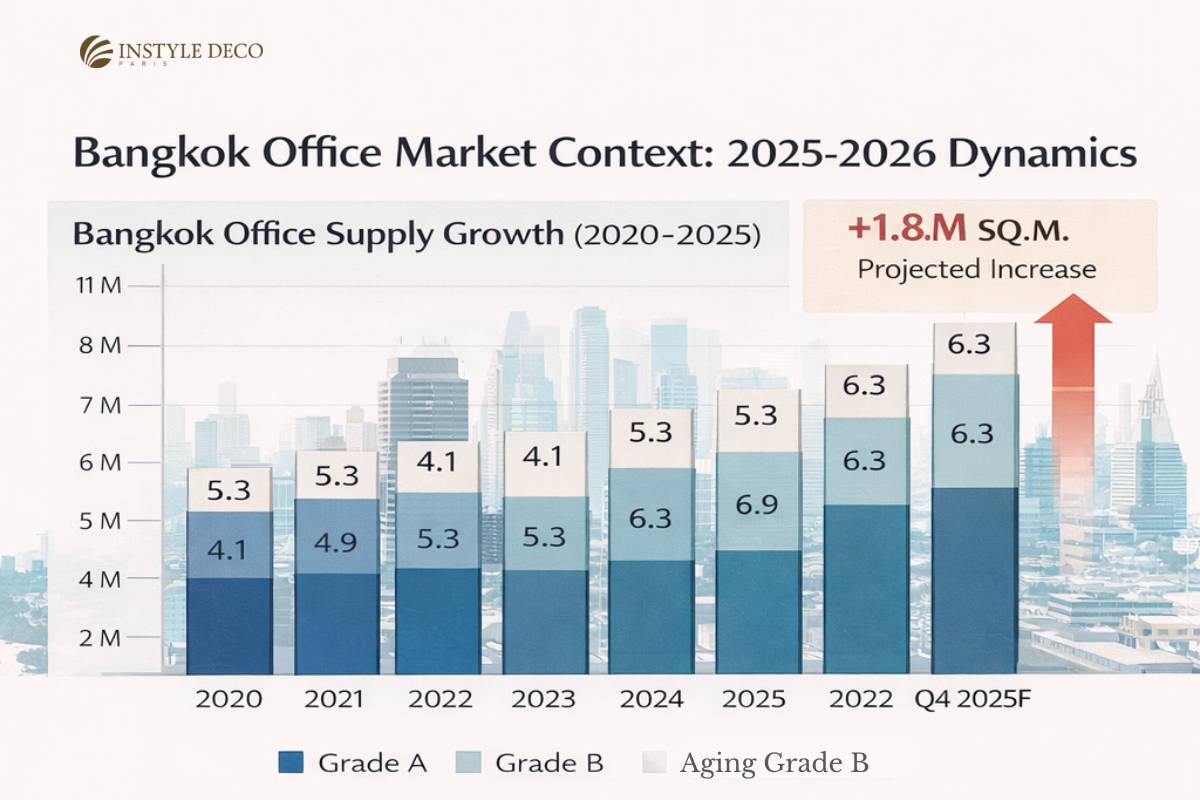
The Bangkok Office Market Context: 2025-2026 Dynamics
Bangkok’s commercial real estate sector enters 2026 with a nuanced trajectory: Grade A office rents stabilize between THB 700-900 per square meter monthly in central business districts, while occupancy rates hover at 75-78%, compelling landlords to differentiate through design rather than price alone. Cushman & Wakefield’s 2025 market analysis indicates that tenants increasingly prioritize “flight-to-quality” moves, favoring spaces with embedded flexibility over traditional fixed layouts.
This market pressure accelerates the obsolescence of rigid open-plan concepts implemented during 2010-2019. Modern leasing agreements in Bangkok now frequently incorporate “design-and-build” clauses allowing tenants to reconfigure 40-60% of floor plates within lease terms, reflecting demand for adaptable infrastructure. The implication for open-plan office design Bangkok practitioners is clear: permanence is liability, and modularity functions as economic hedge against workspace evolution.
The Collaboration-Privacy Paradox: Evidence from Longitudinal Studies
The foundational premise of open-plan design is simply uninterrupted visibility catalyzes innovation, which confronts contradictory empirical evidence. A fourteen-month longitudinal case study tracking employee wellbeing in converted open-plan environments documents statistically significant declines in concentration metrics and perceived autonomy, with 67% of participants reporting increased cognitive load within six months of transition. These findings align with broader workplace research indicating that sensory overload from unmitigated acoustic and visual stimuli reduces deep-work productivity by 15-30% in purely open configurations.
However the antithesis of open plan, a fully enclosed cellular offices, exhibits inverse failures: decreased knowledge transfer and weakened organizational culture. The resolution lies not in spatial absolutism but in gradient privacy. Lencore’s productivity research demonstrates that optimal environments provide “controlled proximity”, meaning visual openness maintained through glass partitions and low panels (under 1.2 meters), coupled with acoustic separation achieving Noise Reduction Coefficients (NRC) of 0.70-0.85 in focus zones.
For Bangkok specifically, cultural factors amplify this tension. Thai business communication relies heavily on non-hierarchical, face-to-face consensus-building (nam jai dynamics), favoring accessibility. Yet tropical environmental psychology suggests that heat and humidity increase sensitivity to crowding and noise, necessitating enhanced spatial buffers compared to temperate climates.
Activity-Based Working: From Concept to Architectural Program
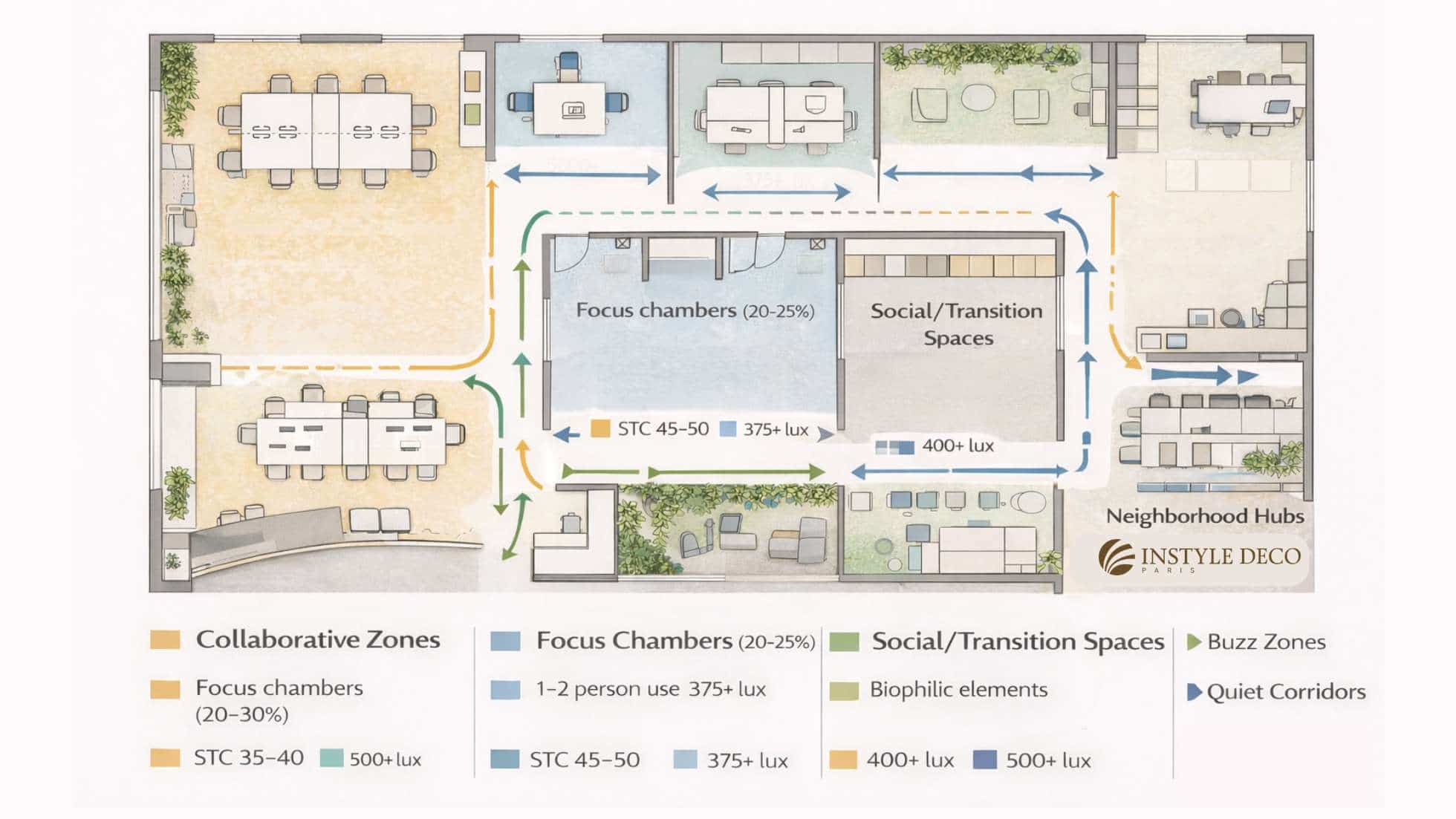
Activity-Based Working (ABW) transcends the “hot-desking” misnomer, representing instead a programmatic taxonomy of work modes mapped to specialized zones. Effective modern office layout implementation requires four distinct spatial categories, each with measurable performance criteria:
Collaborative Zones (30-35% of floor plate)
- Ceiling heights minimum 3.0 meters to prevent acoustic trapping
- Writable surfaces covering 40% of wall area
- Technology: Wireless presentation systems with <2-second latency
- Furnishing: Modular tables reconfigurable within 60 seconds for 4-12 person arrangements
Focus Chambers (20-25% of floor plate)
- Acoustic isolation: STC (Sound Transmission Class) 45-50 rating
- Visual privacy: Frosted glass or solid walls with 1.8-meter minimum height
- Environmental control: Individual HVAC vents or floor fans (critical in Bangkok’s climate)
- Occupancy: Single or 2-person maximum to prevent conversation drift
Social/Transition Spaces (15-20% of floor plate)
- Biophilic elements: Living walls or water features masking background noise (frequency masking at 1000-4000 Hz)
- Residential-grade furniture reducing corporate fatigue
- Proximity to natural light (within 6 meters of windows per LEED v4 standards)
Neighborhood Hubs (remaining percentage)
- Team-identified territories with shared storage and identity markers
- Acoustic buffers from circulation paths using bookshelves or planting
Zoning Strategies for Bangkok’s Built Environment
Bangkok’s existing office stock—much constructed during 1995-2010—presents retrofit challenges: 2.7-meter ceiling heights, central air conditioning limitations, and column grids restricting layout fluidity. Successful collaborative workspace design in these constraints employs “micro-zoning” rather than wholesale reconstruction.
The Gradient Approach:
Rather than binary open/closed distinctions, implement four privacy tiers:
- The Forum: Completely open, high-energy zone near reception (ambient noise 55-60 dB acceptable)
- The Studio: Semi-open with acoustic ceiling baffles and screens (target 45-50 dB)
- The Library: Quiet zone with phone-booth style pods and “library rules” (40-45 dB maximum)
- The Vault: Fully enclosed meeting rooms and focus rooms (35-40 dB, STC 50+ walls)
Circulation as Buffer:
In tropical climates, airflow patterns become zoning tools. Position high-energy collaborative zones to intercept natural ventilation paths from operable windows (where code permits) or HVAC supply vents, using thermal comfort to reinforce spatial identity. Conversely, place focus zones in thermally stable interior areas with dedicated mini-split units preventing temperature fluctuations that disrupt concentration.
Acoustic Engineering: Technical Specifications
Noise represents the primary failure mode of open-plan implementation. Effective office interior design requires treatment across three acoustic domains:
Absorption (Reducing Reverberation):
- Ceiling: Install NRC 0.90-1.00 acoustic clouds or baffles covering 40-50% of ceiling area above work zones
- Walls: Tectum or fabric-wrapped panels at 50% wall coverage minimum in collaborative areas
- Flooring: Carpet tile with 6mm pile height and acoustic backing (Impact Insulation Class IIC 50+) outperforms hard surfaces by 15-20 dB
Blocking (Preventing Transmission):
- Partitions: From floor to structure (not just ceiling tiles) for focus rooms; 100mm stud walls with mineral wool insulation
- White noise/masking: Install sound masking systems generating 47-48 dB of shaped spectrum (specifically effective 100-5000 Hz) to cover speech intelligibility at 3-meter distances
Covering (Psychoacoustic Management):
- Biophilic soundscaping: Water features generating 42-45 dB mask intermittent speech
- Background music: In social zones, 60-65 BPM tempo music reduces perceived urgency without lyric distraction
Biophilic Integration and Wellness Standards
2026 office design trends emphasize that open-plan environments must counteract stress through biophilic intervention. Research indicates that visible greenery within 5 meters of workstations reduces cortisol levels by 12-15% compared to pure artificial environments—critical in Bangkok where urban views offer limited natural restoration.
Implementation Standards:
- Living walls: 1 square meter of plant wall per 10 square meters of floor area, targeting species with high transpiration rates (peace lily, snake plant) for humidification benefits
- Natural light: 75% of workstations within 7.5 meters of windows; circadian lighting systems in interior zones matching 5500K-3000K color temperature shifts
- Materials: Low-VOC finishes mandatory given Bangkok’s existing outdoor air quality challenges; wood elements providing visual warmth to counteract glass/concrete sterility
Read more about Biophilic Office design here.
Technology Infrastructure for Hybrid Work
Modern open-plan offices function as broadcast studios for remote participants. Technical infrastructure standards for 2026:
Network: Wi-Fi 6E coverage with -65 dBm signal strength throughout; dedicated IoT network segment for environmental controls
Audio-Visual: Ceiling-mounted beamforming microphone arrays (8+ elements) capturing 360-degree audio in collaborative zones; 4K displays minimum 85 inches for visibility across open areas
Power: Floor boxes every 3 meters or wireless charging integrated into 30% of furniture; USB-C power delivery (100W) standard
Critically, technology must disappear—cables and visible hardware generate visual clutter that amplifies the cognitive load already stressed by open visibility. Under-floor busway systems or ceiling-mounted utility drops preserve aesthetic cleanliness.
Implementation Challenges: Tropical and Cultural Considerations
Bangkok’s climate imposes unique constraints on open-plan viability. High humidity (70-80% year-round) limits certain acoustic materials susceptible to mold; closed-cell foam or mineral wool with anti-microbial treatments become necessities over organic options. Additionally, Thai cultural preferences for “saving face” create unique acoustic privacy needs—conversations regarding performance or conflict require genuinely private spaces, as partial privacy creates psychological exposure distinct from Western contexts.
Cost parameters in Bangkok’s 2026 market indicate that comprehensive open-plan retrofits range THB 25,000-45,000 per square meter, with acoustic treatments representing 18-22% of that budget. However, productivity gains from proper zoning yield payback periods of 14-18 months based on reduced sick leave and attrition costs.
Conclusion: The Post-Open Paradigm
Open-plan office design in Bangkok has evolved from democratic idealism to engineered ecosystem. The 2026 standard rejects the false dichotomy of collaboration versus privacy, instead implementing granular spatial portfolios where employees navigate between interaction and isolation as cognitive demands dictate. Success requires treating acoustic engineering as structural necessity, not finish detail, and recognizing that in tropical, high-density business environments like Bangkok, sensory management determines productivity more than aesthetic openness.
For organizations evaluating office interior design strategies, the metric shifts from “square meters per person” to “zone appropriateness per task.” Bangkok’s competitive commercial landscape increasingly rewards this sophistication with tenants and employees alike voting with their presence for environments that respect both the social necessity of collaboration and the biological imperative of cognitive restoration.
Strategic Implementation Support
Translating these acoustic and zoning specifications into built reality requires specialized expertise in Bangkok’s regulatory environment, supply chain constraints, and tropical material performance. Our practice provides end-to-end open-plan office design Bangkok services, from initial spatial analytics and employee workflow studies through acoustic engineering specification and biophilic system integration. We maintain particular depth in Activity-Based Working implementations for multinational corporations, tech sector scaling operations, and financial services firms navigating hybrid work transitions.
Recent deployments include 1,200+ square meter floor plates in Asoke and Sathorn districts achieving STC 50+ focus room isolation within existing 2.7-meter ceiling constraints, and ABW retrofits delivering 23% measurable productivity gains through gradient zoning strategies. For organizations preparing 2026 workspace strategies, we offer preliminary spatial audits assessing current floor plates against the zone distribution and acoustic criteria outlined above, identifying retrofit priorities without commitment to full design engagement.