
Qi (pronounced “chee”) is the concept of life force energy that flows through all living things according to traditional Chinese philosophy. In interior design, Qi refers to the flow of energy within a space and how that energy affects the wellbeing, mood, and prosperity of the people who occupy it. Interior designers who understand Qi principles create spaces that feel harmonious, balanced, and supportive rather than chaotic or draining.
This guide explains what Qi is in interior design, how it influences room layouts, and practical ways to apply energy flow principles in contemporary homes without sacrificing modern aesthetics.
What Is Qi and Why Does It Matter in Interior Design?
Qi is the invisible life force that moves through everything. In interior design terms, Qi represents how energy circulates through a room, a home, or a building. Good Qi flows smoothly like a gentle stream. Bad Qi becomes stagnant like a clogged drain or rushes too fast like a raging river.
When Qi flows well in a space, people feel comfortable, relaxed, and energized. When Qi is blocked or chaotic, people feel uneasy, tired, or stressed without knowing why. This explains why some rooms feel welcoming while others feel off despite expensive furniture.
How Does Qi Differ from Feng Shui?
Qi and Feng Shui are related but not identical. Feng Shui is the comprehensive system of arranging spaces to optimize Qi flow. Qi is the energy itself that Feng Shui aims to direct.
Think of Qi as the water in a river and Feng Shui as the riverbanks and channels that guide the water. You cannot have Feng Shui without Qi, but Qi exists whether or not anyone applies Feng Shui principles.
| Aspect | Qi | Feng Shui |
|---|---|---|
| Definition | Life force energy | System for managing energy |
| Scope | Universal energy flow | Specific techniques and rules |
| Application | Felt and experienced | Practiced and applied |
| Origin | Chinese philosophy | Chinese environmental science |
Why Do Luxury Homeowners Care About Qi?
High net worth individuals increasingly seek spaces that support wellness alongside aesthetics. According to the Global Wellness Institute, the wellness real estate market reached $438 billion in 2023 and continues growing. Qi principles offer a framework for creating homes that feel genuinely restorative rather than merely impressive.
Qi-focused design addresses common complaints from luxury homeowners:
- Spaces that look beautiful but feel cold or uncomfortable
- Rooms where conversation never flows naturally
- Bedrooms that look luxurious but disrupt sleep
- Home offices that drain energy instead of supporting focus
How Does Qi Flow Through Interior Spaces?
Qi moves through spaces like air or water. It enters through doors and windows, circulates through rooms, and exits or gets absorbed. The layout, furniture placement, colors, materials, and even the shapes of objects all affect how Qi moves.
What Helps Qi Flow Smoothly?
Several factors support healthy Qi circulation:
Clear pathways: Qi needs unobstructed routes to move. Furniture that blocks natural walking paths also blocks energy flow. Hallways should remain clear. Doorways need full clearance to open.
Balanced shapes: Rounded furniture and curved layouts allow Qi to flow gently. Sharp corners and angular arrangements create harsh energy that feels aggressive or uncomfortable.
Natural elements: Wood, stone, plants, and water features connect interior spaces to natural Qi sources. These elements ground energy and prevent spaces from feeling sterile.
Proper lighting: Natural light carries strong Qi. Dark spaces stagnate energy. A mix of ambient, task, and accent lighting keeps energy moving at appropriate levels for each activity.
What Blocks or Disturbs Qi?
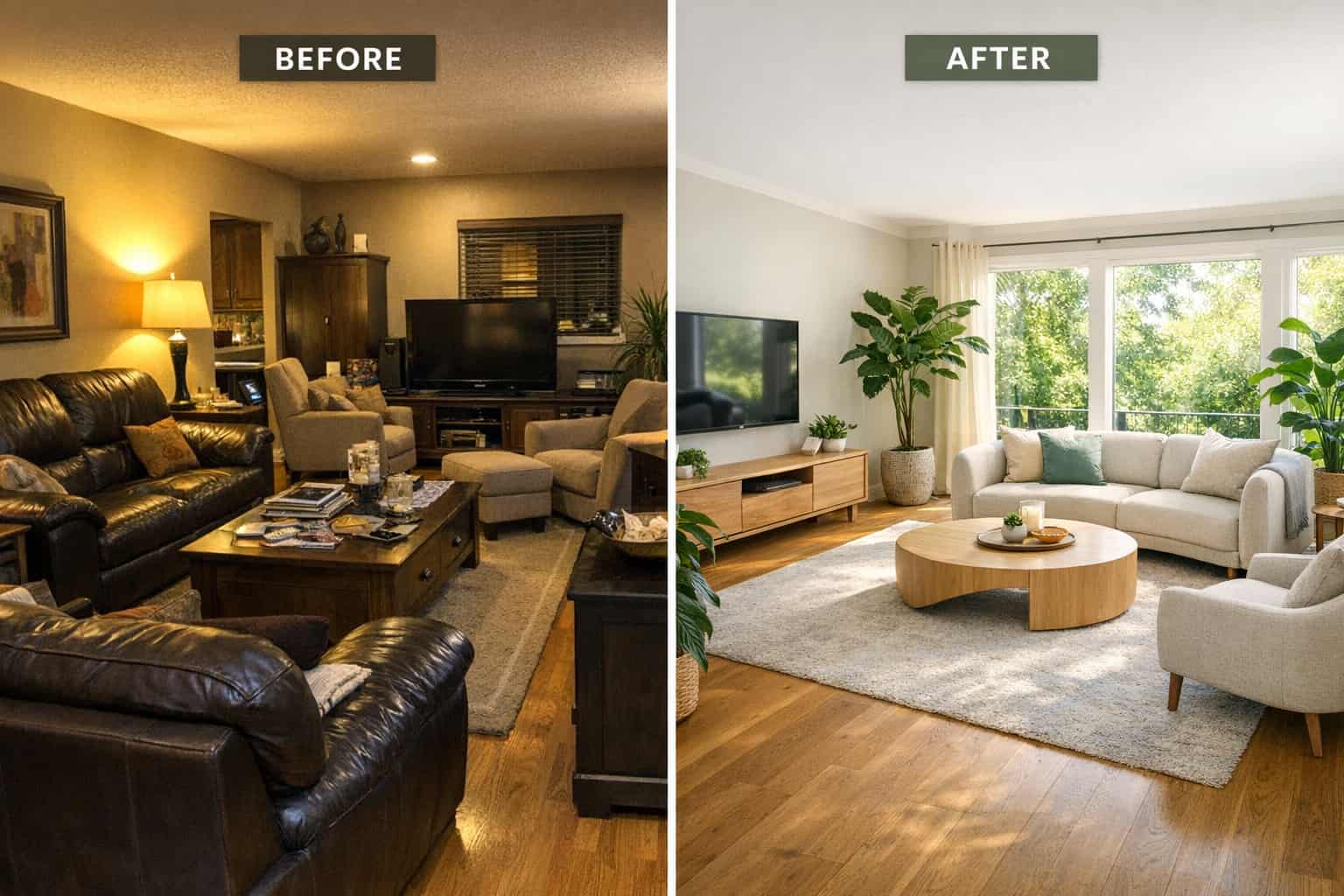
Several common design choices disrupt energy flow:
Clutter: Piles of objects, especially in corners or hidden storage, create stagnant Qi. Even organized clutter in closets affects the energy of adjacent spaces.
Direct alignment: Doors that line up with other doors or windows create rushing Qi that moves too fast. This feels unsettling and prevents spaces from feeling settled.
Broken or damaged items: Cracked mirrors, burnt-out bulbs, and broken furniture hold stuck energy. These items should be repaired or removed promptly.
Harsh materials: Excessive metal, glass, and synthetic materials without natural elements create cold, hard energy. Balance is essential.
How Should You Arrange Furniture for Good Qi?
Furniture placement is the most practical way to influence Qi in any space. The right arrangement creates flow. The wrong arrangement creates obstacles.
What Is the Command Position?
The command position is fundamental to Qi-based furniture arrangement. This means placing the main piece of furniture (bed, desk, sofa) so you can see the door while not being directly in line with it.
Bed placement: Position the bed so you can see the bedroom door from lying down, with space on both sides. Avoid placing the bed directly opposite the door or under a window.
Desk placement: Place your desk so you face the room entrance. Your back should not be to the door, which creates vulnerability and distraction.
Sofa placement: Position the main sofa against a solid wall with a clear view of the room entrance. Avoid floating sofas in the middle of large spaces without grounding elements.
How Should You Arrange Living Room Furniture?
The living room is where people gather, so Qi should encourage conversation and connection.
Create a focal point: Every living room needs a clear center of attention, whether a fireplace, artwork, or view. Furniture should orient toward this point.
Allow conversation flow: Arrange seating so people can talk without shouting or twisting. Sofas and chairs should face each other rather than all pointing at a television.
Leave breathing room: Qi needs space to circulate. Avoid pushing all furniture against walls. Leave comfortable gaps between pieces.
Use area rugs wisely: Rugs anchor furniture groupings and define Qi zones. A rug should be large enough that all main furniture pieces touch it at least partially.
How Should You Arrange Bedroom Furniture?
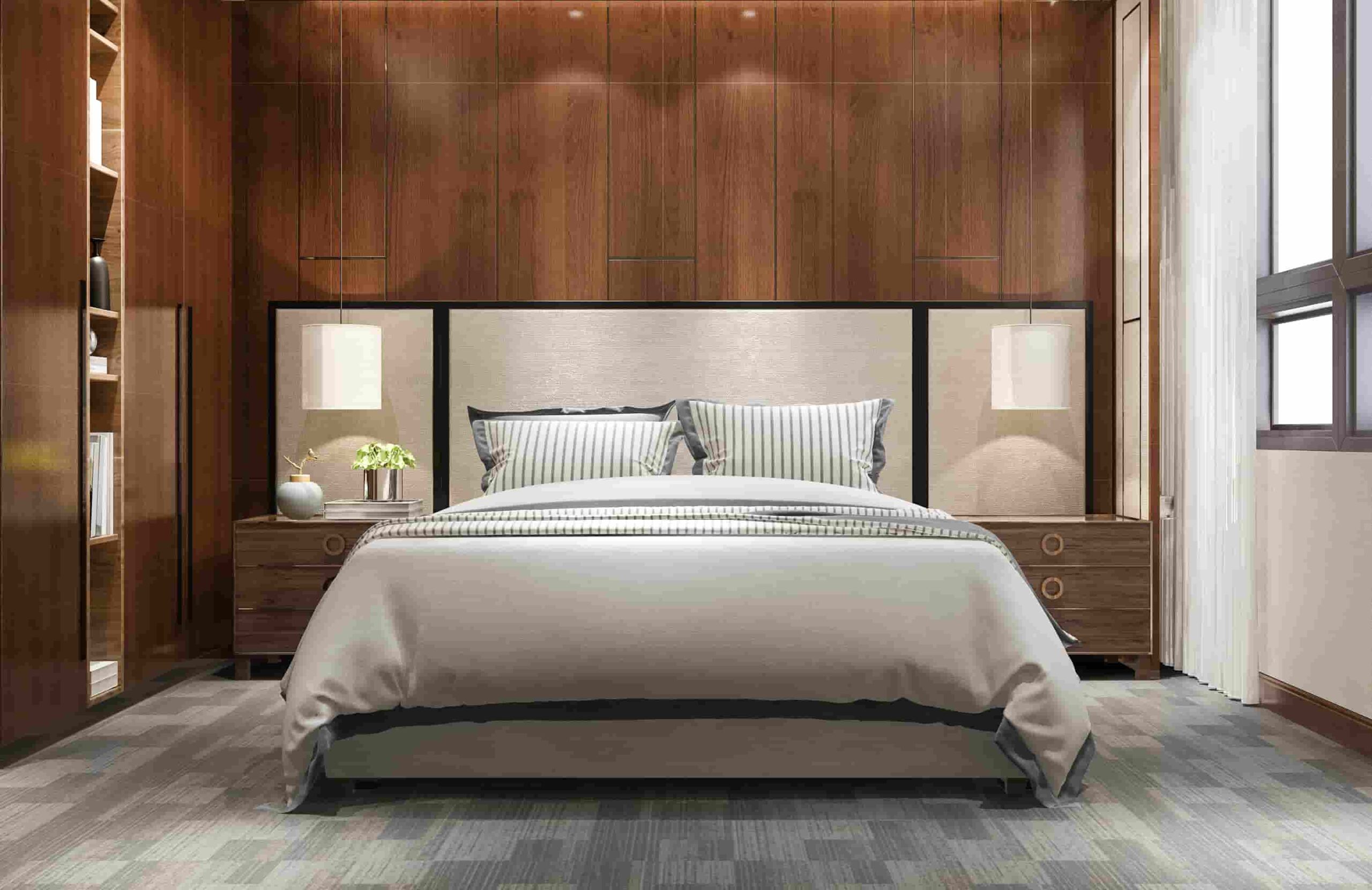
The bedroom supports rest and intimacy, so Qi should feel calm and secure.
Prioritize the bed: The bed is the most important piece for Qi. It needs a solid headboard, space on both sides, and a clear view of the door.
Minimize electronics: Televisions, computers, and exercise equipment introduce active Qi that disrupts sleep. Keep these out of the bedroom or hidden when not in use.
Balance nightstands: Matching nightstands on both sides of the bed creates symmetry that supports balanced relationships and restful sleep.
Soften sharp corners: Nightstands and dressers often have sharp corners pointing at the bed. Round these corners with plants or fabric to soften the energy.
How Do the Five Elements Influence Interior Design?
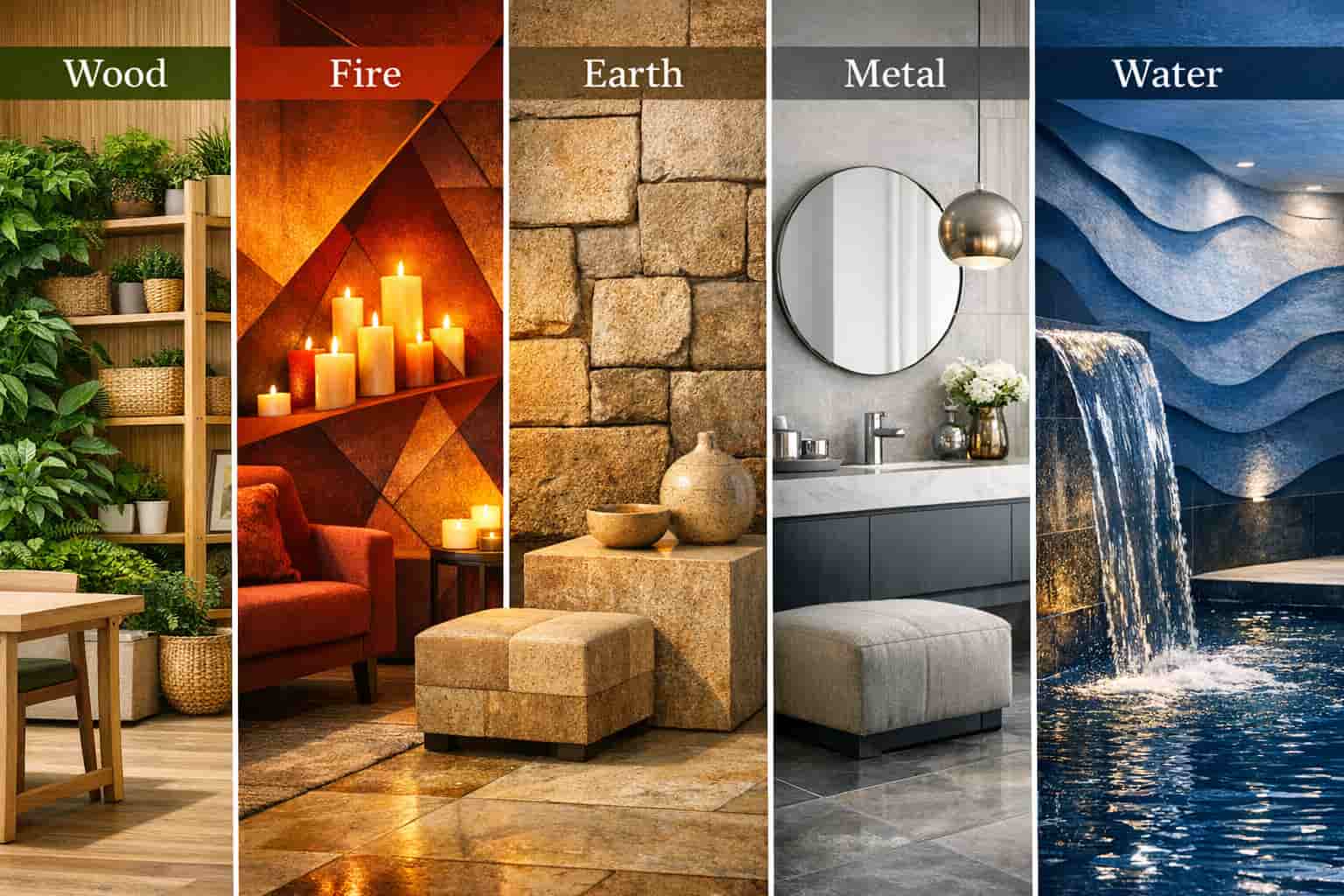
The five elements (wood, fire, earth, metal, water) provide a framework for balancing Qi through materials, colors, and shapes. Each element brings specific qualities to a space.
What Are the Five Elements and Their Qualities?
| Element | Qualities | Materials | Colors | Shapes |
|---|---|---|---|---|
| Wood | Growth, vitality | Wood furniture, plants | Green, teal | Rectangular, columnar |
| Fire | Energy, passion | Candles, lighting | Red, orange, pink | Triangular, pointed |
| Earth | Stability, nourishment | Stone, tile, ceramics | Yellow, brown, beige | Square, flat |
| Metal | Clarity, precision | Metal fixtures, frames | White, gray, silver | Round, spherical |
| Water | Flow, abundance | Fountains, mirrors | Black, navy blue | Wavy, irregular |
How Do You Balance Elements in a Room?
Every room needs all five elements represented, but the proportions vary by room purpose.
Living rooms benefit from more fire (conversation, activity) and wood (growth, family). Balance with earth elements for stability.
Bedrooms need more earth (rest, grounding) and metal (clarity, calm). Minimize fire elements that create excessive activity.
Home offices benefit from metal (focus, precision) and water (flow, ideas). Add wood for growth and creativity.
Kitchens naturally contain fire (stove) and water (sink). Balance with earth and wood elements.
What Happens When Elements Are Out of Balance?
Too much of any element creates specific problems:
- Excess fire: Arguments, burnout, inability to relax
- Excess wood: Feeling overwhelmed, inability to complete projects
- Excess earth: Stagnation, heaviness, feeling stuck
- Excess metal: Coldness, rigidity, overthinking
- Excess water: Emotional overwhelm, instability, lack of focus
How Does Color Affect Qi in Interior Spaces?
Color is one of the most powerful ways to influence Qi because color is energy. Different colors carry different vibrations that affect mood, energy level, and perception of space.
What Colors Support Different Types of Qi?
Warm colors (red, orange, yellow): Activate Qi. These colors stimulate conversation, appetite, and activity. Use them in social spaces like living rooms and dining rooms.
Cool colors (blue, green, purple): Calm Qi. These colors promote relaxation, reflection, and rest. Use them in bedrooms, meditation spaces, and bathrooms.
Neutral colors (white, gray, beige, brown): Ground Qi. These colors provide stability and balance. Use them as foundations that support bolder accent colors.
How Should You Use Color in Different Rooms?
Entryways: Use warm, welcoming colors that invite Qi into the home. Yellow and earth tones work well.
Living rooms: Balance warm and cool colors to support both conversation and relaxation.
Bedrooms: Prioritize cool, calming colors. Blue and green promote restful sleep.
Home offices: Use colors that support focus without causing fatigue. Green and blue work well. Add yellow accents for mental clarity.
Kitchens: Warm colors stimulate appetite. Red and orange are traditional kitchen colors for good reason.
How Can You Apply Qi Principles Without Looking Dated?
Many homeowners worry that Qi-based design means Asian-themed decor. This is not true. Qi principles work with any aesthetic from minimalist modern to classic European.
How Do You Modernize Qi Principles?
Focus on function over form: The principles matter more than the symbols. Clear pathways and balanced arrangements look modern in any style.
Choose contemporary materials: Use Qi principles with glass, steel, concrete, and other modern materials. Natural materials are ideal but not mandatory.
Embrace minimalism: Qi loves uncluttered spaces. Minimalist design naturally supports good energy flow.
Integrate technology thoughtfully: Hide cables, use smart lighting to adjust Qi by time of day, and keep screens from dominating spaces.
What Does Qi-Optimized Modern Design Look Like?
A Qi-optimized contemporary Parisian apartment might feature:
- Clean lines and uncluttered surfaces (good Qi flow)
- Natural light maximized through large windows (strong Qi source)
- Curved sofa and rounded coffee table (gentle energy)
- Strategic plant placement for natural element balance
- Neutral foundation with carefully chosen accent colors
- Furniture arranged for conversation and clear pathways
- Quality materials that feel good to touch (sensory Qi support)
Nothing about this design looks traditionally Asian or dated. It simply feels harmonious and supportive.
Conclusion
Qi in interior design is ultimately about creating spaces that do more than look beautiful—they need to feel balanced, calming, and supportive of everyday life. When energy flows naturally through a home, the result is a space that feels welcoming, restorative, and intuitively comfortable. At Instyle Deco Paris, we interpret these principles through a refined, contemporary lens, blending timeless harmony with elegant bangkok interior design to create interiors that are both visually sophisticated and emotionally grounding.
Rather than relying on decorative clichés, good Qi comes from thoughtful layout, balanced materials, natural light, and purposeful design choices that improve how people live within a space. This is where expert planning makes the difference. As a studio known for premium interior design service in bangkok, Instyle Deco Paris helps homeowners transform abstract concepts like energy flow into real, livable environments—homes that not only reflect personal style, but also support wellbeing, comfort, and harmony every day.
FAQ: Qi in Interior Design
What is Qi in simple terms?
Qi is life force energy. In interior design, it describes how energy flows through spaces and affects how people feel in those spaces.
Is Qi the same as Feng Shui?
No. Qi is the energy itself. Feng Shui is the system of arranging spaces to optimize Qi flow. You can work with Qi principles without following every Feng Shui rule.
How do I know if my home has good Qi?
Good Qi feels comfortable and supportive. People sleep well, conversation flows, and the space feels welcoming. Bad Qi feels off despite attractive furnishings.
Can I apply Qi principles to a modern home?
Yes. Qi principles work with any aesthetic. Focus on clear pathways, balanced arrangements, natural light, and quality materials rather than specific decorative styles.
Do I need a Feng Shui consultant to optimize Qi?
Not necessarily. Many Qi principles are common sense once you understand them. Professional consultation helps for complex spaces or persistent problems.
How does clutter affect Qi?
Clutter blocks Qi flow and creates stagnant energy. Even organized clutter affects adjacent spaces. Regular clearing supports healthy energy circulation.
What is the best bed position for good Qi?
Place the bed so you can see the door while lying down, with space on both sides. Avoid positioning directly in line with the door or under windows.
How do colors affect Qi?
Warm colors (red, orange, yellow) activate energy. Cool colors (blue, green) calm energy. Neutrals ground and balance.
What are the five elements in Qi design?
Wood, fire, earth, metal, and water. Each element brings specific qualities. Balanced spaces include all five elements in appropriate proportions.
Can bad Qi make you sick?
While Qi is not a medical concept, poor spatial design can cause stress, poor sleep, and low energy. These factors affect health over time.
How quickly does changing furniture arrangement affect Qi?
People often notice immediate improvements in how a space feels. Longer term benefits develop as new patterns become established.
Should every room have the same Qi balance?
No. Different rooms serve different purposes and need different Qi qualities. Bedrooms need calm energy while living rooms benefit from more activation.
Sources
[^1^]: Global Wellness Institute. “Global Wellness Economy Monitor 2023.” The wellness real estate market reached $438 billion in 2023.
[^2^]: The Interior Design Institute. “Feng Shui Design Principles.” Comprehensive guide to energy flow in interior spaces, approximately 2,200 words covering basic principles and applications.
[^3^]: Traditional Chinese Medicine theory references the concept of Qi as life force energy circulating through all living things and spaces.
[^4^]: Environmental psychology research supports the connection between spatial arrangement and human wellbeing, though using different terminology than traditional Qi concepts.