
Creating a home theatre that rivals commercial cinema experiences requires more than high-quality equipment. The room itself plays a major role in how clear, immersive, and powerful the sound feels.
In luxury residential projects, especially in dense urban environments like Bangkok, condominiums and apartments often come with added acoustic challenges. Room size, wall construction, HVAC noise, and nearby neighbours can all affect the final experience. With the right acoustic design, an ordinary media room can become a refined entertainment space that sounds as good as it looks.
How Do Home Theatre Acoustics Work?
Sound follows predictable physics principles. Once you understand how sound behaves inside a room, it becomes easier to make better decisions about room layout, acoustic treatment, and equipment placement.
Sound Interacts with Rooms in Three Main Ways
When speakers produce sound, the sound waves interact with the room’s walls, ceiling, floor, furniture, and surfaces.
Reflection happens when sound bounces off hard surfaces. This can create echoes and reverberation, making dialogue and sound effects feel less clear. First reflections are especially important because they reach the listener shortly after the direct sound from the speaker.
Absorption uses soft or porous materials to reduce unwanted reflections. These materials convert sound energy into a small amount of heat, helping to control echo and improve clarity.
Diffusion scatters sound in different directions instead of absorbing it completely. This helps maintain a lively sound while reducing harsh reflections and flutter echo.
Key Acoustic Terms Help Explain Sound Quality
Reverberation Time (RT60) refers to how long it takes for sound to decay by 60 decibels after the source stops. Home theatres usually target around 0.3 to 0.5 seconds at mid-frequencies, which is shorter than a living room but not as dry as a recording studio.1
Frequency Response describes how evenly a room reproduces sound across the audible range of 20 Hz to 20 kHz. A flatter response means the sound is more accurate and less colored by the room.
Sound Pressure Level (SPL) measures volume in decibels. Cinema reference levels can peak at 105 dB per channel, while subwoofers may reach 115 dB.2
Signal-to-Noise Ratio compares the desired sound to unwanted background noise. A quality home theatre should maintain at least a 35 dB difference between the audio and background noise.
What Room Design Factors Affect Home Theatre Sound?
Room shape, size, and proportions strongly influence acoustic performance. Even if the room already exists, understanding these basics helps guide improvements.
Room Dimensions Affect Bass Performance
Room proportions have a major effect on low-frequency sound. Parallel walls can create standing waves, where some bass frequencies become too strong while others cancel out.
Common room ratio guides include:
| Ratio Type | Purpose |
| Classic Golden Ratio | Uses 1 : 1.6 : 2.6 for height, width, and length |
| Bolt Area Ratios | Helps avoid overlapping room modes |
| Sepmeyer Ratios | Useful for small-room acoustic planning |
For example, a home theatre with a 2.7-metre ceiling may ideally be around 2.7m × 4.3m × 7m. However, most existing rooms will not match perfect ratios, so acoustic treatment is often needed to manage problem frequencies.
Larger Rooms Usually Perform Better
Larger rooms generally offer better acoustic performance because they allow sound to spread more naturally.
They also provide:
- Smoother bass distribution
- More space for speaker and seating placement
- Better handling of high sound pressure levels
- Reverberation that is easier to control
A dedicated home theatre should ideally have at least 50 cubic metres of room volume. Below this size, it becomes harder to achieve powerful sound without excessive pressure, distortion, or uneven bass.
Shape and Symmetry Influence Sound Balance
Rectangular rooms are usually preferred because their acoustic behaviour is easier to predict and treat.
Irregular rooms with angled walls or ceilings can reduce flutter echo, but they also make bass control more complicated.
Left-right symmetry is important because it supports balanced stereo imaging. If one side of the room is very different from the other, the speakers may sound uneven.
Where Should Speakers Be Placed in a Home Theater?
Proper speaker placement helps the system perform at its best. Even expensive speakers can sound poor if they are placed incorrectly.
A 5.1 System Uses Five Speakers and One Subwoofer
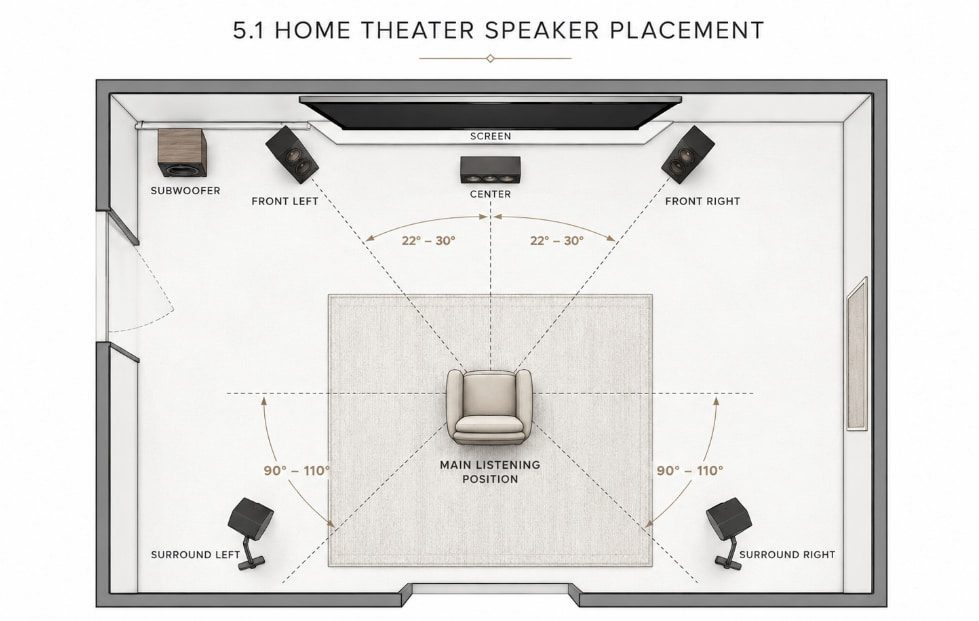
A standard 5.1 setup includes left, centre, right, surround speakers, and one subwoofer.
Typical placement:
- Left and right speakers: 22° to 30° from the centre line
- Center speaker: Directly above or below the screen
- Surround speakers: 90° to 110° from the centre
- Subwoofer: Often placed near the front third of the room
The center speaker should be positioned close to ear height when possible because it carries most movie dialogue.
A 7.1 System Adds More Surround Detail
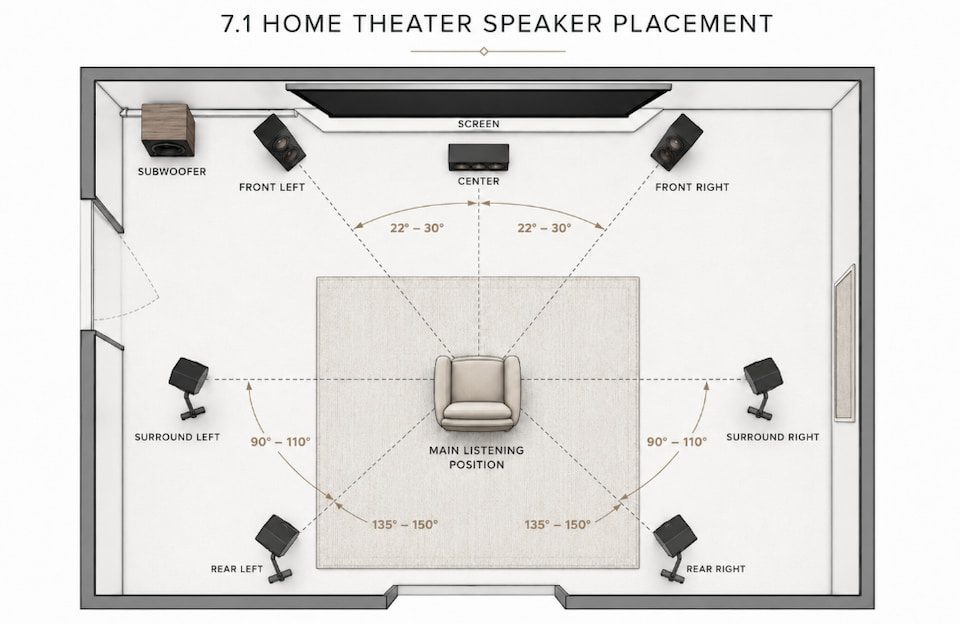
A 7.1 system adds two extra speakers for better surround separation.
In this layout:
- Side surrounds are placed around 60° to 90°
- Rear surrounds are placed around 135° to 150°
This creates a more detailed surround field, especially in larger home theatres.
Dolby Atmos Adds Height Effects
Dolby Atmos uses ceiling speakers or upward-firing modules to create a three-dimensional sound field.
For best results, the ceiling height should usually be between 2.4 and 3.6 metres. Very low ceilings can limit the effectiveness of height effects.
The 38% Rule Helps Improve Bass at the Main Seat
The 38% rule suggests placing the main listening position about 38% of the room length from the front wall. This position usually reduces the impact of axial room modes and gives smoother bass response.3
It is not a strict rule, but it is a useful starting point. Seating should also avoid the exact centre of the room because this is often where bass cancellation is strongest.
How Should Subwoofers Be Placed?
Subwoofer placement has a major impact on bass quality. Bass frequencies interact strongly with the room, so placement can either improve or worsen the listening experience.
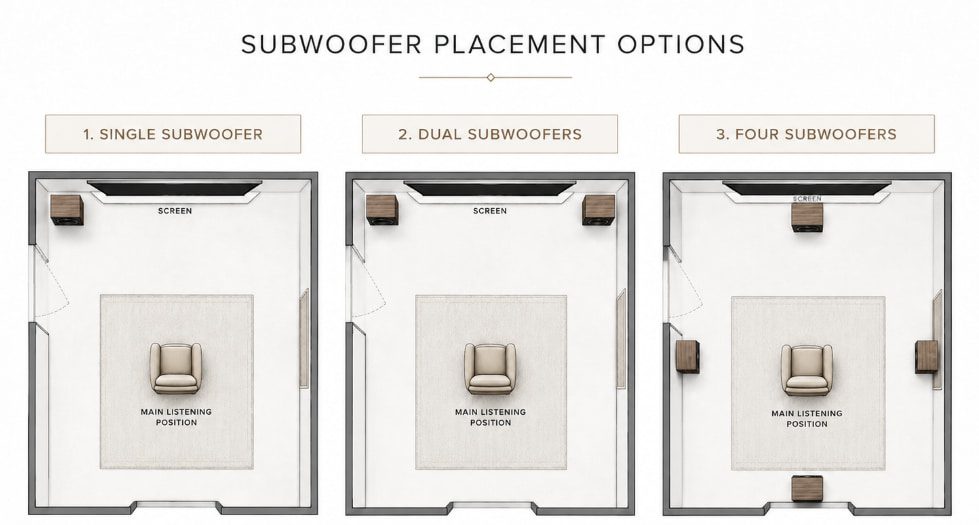
One Subwoofer Gives Output but May Sound Uneven
A single subwoofer is often placed along the front wall or in a corner. Corner placement can increase output, but it may also create uneven bass across the room.
Two Subwoofers Usually Improve Bass Smoothness
Dual subwoofers can provide more consistent bass across different seats. Common placements include:
- Both front corners
- Midpoints of opposite walls
- Front and rear wall positions
This helps reduce large peaks and dips in bass response.
Four Subwoofers Offer the Most Consistent Bass
Using four subwoofers, often placed at the midpoint of each wall, can provide the smoothest seat-to-seat bass consistency.
For apartments and condos, subwoofer isolation is especially important. Decoupled platforms and placement away from shared walls can reduce vibration transfer to neighboring units.
What Acoustic Treatment Does a Home Theatre Need?
Acoustic treatment improves clarity, balance, and immersion. The goal is not to make the room completely dead, but to control the reflections and frequencies that cause problems.
Absorption Controls Reflections and Echo
Absorption is used to reduce unwanted sound reflections.
Important treatment areas include:
First reflection points: These are areas where sound bounces from the speakers to the listener after hitting a side wall. The mirror technique is commonly used to identify these points.
Ceiling reflections: Ceiling reflections can affect clarity, especially above the main listening area. Acoustic cloud panels are often used here.
Rear wall: The wall behind the listener can cause strong reflections. Absorption here improves dialogue clarity and imaging.
Bass traps: Low frequencies are harder to control because bass wavelengths are long. Corner bass traps, membrane absorbers, and resonant panel traps help manage these issues.
Diffusion Keeps the Room Spacious and Natural
Diffusion scatters sound instead of absorbing it completely. This helps the room feel more spacious while still reducing harsh echoes.
Useful diffusion areas include:
- Rear walls
- Rear side wall sections
- Rear ceiling areas
Diffusion is often used when designers want to maintain energy in the room without making the space sound flat.
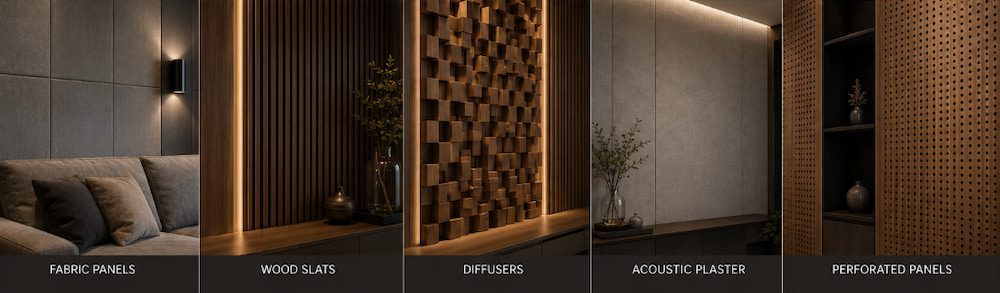
Treatment Materials Can Still Look Luxurious
Acoustic treatment does not have to look technical or unattractive. In luxury interiors, treatment can be integrated into the design.
Common options include:
| Treatment Material | How It Helps | Design Benefit |
| Fabric-wrapped panels | Absorb reflections | Can match interior fabrics |
| Wood diffusers | Scatter sound | Adds architectural detail |
| Perforated panels | Absorb and reflect sound | Works well with millwork |
| Hidden treatment | Controls acoustics discreetly | Maintains a clean design |
What Acoustic Challenges Do Condos and Apartments Have?
Bangkok’s high-rise residential environment creates unique home theatre challenges. In condos and apartments, sound isolation is just as important as sound quality inside the room.
Sound Isolation Reduces Noise Transfer
Sound isolation prevents theatre audio from disturbing nearby units.
Effective strategies include:
- Decoupled wall and ceiling construction
- Resilient channels or isolation clips
- Additional drywall layers
- Mass-loaded vinyl barriers
- Acoustic sealant around gaps and joints
- Floating floors or subwoofer platforms
Sealing is especially important because even small gaps around outlets, doors, and ceiling joints can allow sound to escape.
HVAC Noise Can Reduce Theatre Performance
In tropical climates, air conditioning is essential, but HVAC systems can create unwanted background noise.
Common solutions include:
- Acoustic lining inside ducts
- Vibration isolation for mechanical equipment
- Flexible duct connections
- Dedicated mini-split systems
- Low-velocity duct design
Reducing airflow noise helps preserve dialogue clarity and quiet movie scenes.
Neighbour Considerations Matter in Dense Buildings
In condos and apartments, good theatre design should also consider nearby residents.
Practical approaches include:
- Limiting maximum volume at night
- Using subwoofer isolation platforms
- Avoiding subwoofer placement against shared walls
- Communicating with neighbours when needed
These measures help reduce complaints while still allowing enjoyable theatre performance.
How Can Acoustic Design Work with Luxury Interiors?
Luxury home theatres need to sound excellent without compromising the visual design. This requires acoustic solutions that are either hidden or carefully integrated.
Concealed Treatment Keeps the Room Elegant
Many acoustic treatments can be built into the room design.
Examples include:
Fabric wall systems: These can hide acoustic panels behind decorative fabric.
Custom millwork: Cabinets, columns, and wall features can conceal absorption or diffusion.
Ceiling coffers: Coffered ceilings can improve aesthetics while supporting acoustic treatment.
Acoustic plaster: This provides absorption while maintaining a smooth, seamless finish.
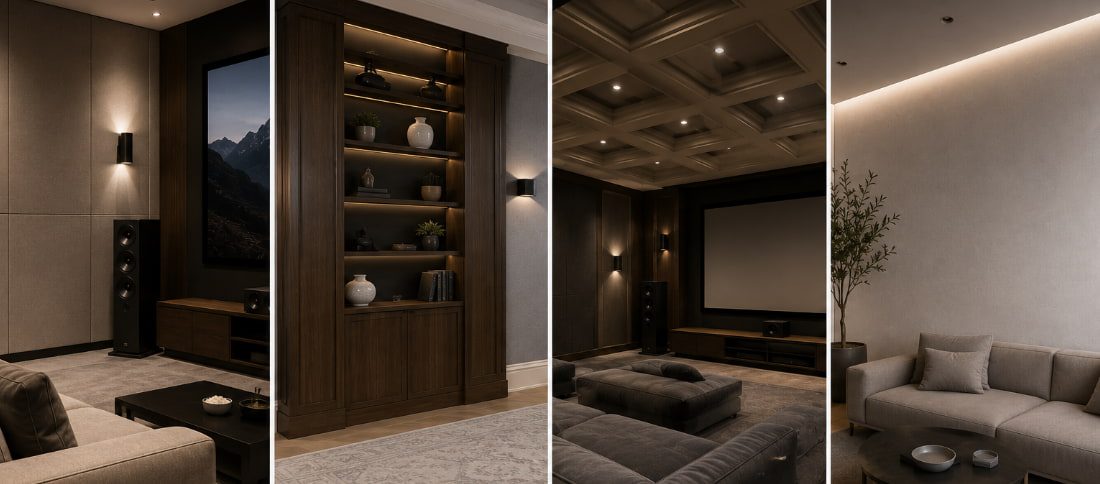
Lighting Can Support Both Mood and Function
Lighting should enhance the theatre experience without interfering with acoustic surfaces.
Useful options include:
- Cove lighting for soft indirect light
- Fibre optic star ceilings for visual impact
- Automated scenes for movies, entertaining, and cleaning
Lighting control helps the room shift between a cinematic space and a luxury entertainment area.
Seating Layout Affects Sound and Comfort
Seating should support both sightlines and acoustic performance.
Tiered seating improves views for rear rows and can also create space for bass trapping beneath risers. Seating fabrics should be selected carefully, especially when absorption is placed behind listeners.
Adequate spacing between rows also helps surround speakers work properly while keeping movement comfortable.
Why Is Calibration Important After Installation?
Even a well-designed room needs calibration. Calibration fine-tunes the system so that the speakers, subwoofers, and room work together properly.
Room Correction Helps Adjust Sound Electronically
Modern AV receivers and processors often include Digital Signal Processing, or DSP. Systems such as Audyssey, Dirac Live, and Anthem Room Correction measure the room and adjust frequency response, timing, and speaker levels.
However, room correction cannot replace physical acoustic treatment. The best results usually come from combining proper room treatment with electronic calibration.
Professional Calibration Gives More Accurate Results
Professional calibrators use measurement microphones and software such as REW or Smaart to analyze the room’s actual response.
They can fine-tune:
- Speaker levels
- Crossover settings
- Subwoofer integration
- Time alignment
- Equalization
A professional report also provides useful documentation for future upgrades or troubleshooting.
How Does Acoustic Design Affect Equipment Selection?
Acoustic design helps determine what type of equipment suits the room. The right speaker or subwoofer depends on room size, layout, and desired performance.
Speakers Should Match the Room
Important speaker factors include:
Sensitivity: Speakers with 90 dB sensitivity or higher need less amplifier power to reach cinema levels.
Directivity: Controlled directivity speakers reduce unwanted sidewall reflections.
Size: Speakers should be appropriate for the room volume. Oversized speakers can overwhelm small rooms, while undersized speakers may struggle in larger spaces.
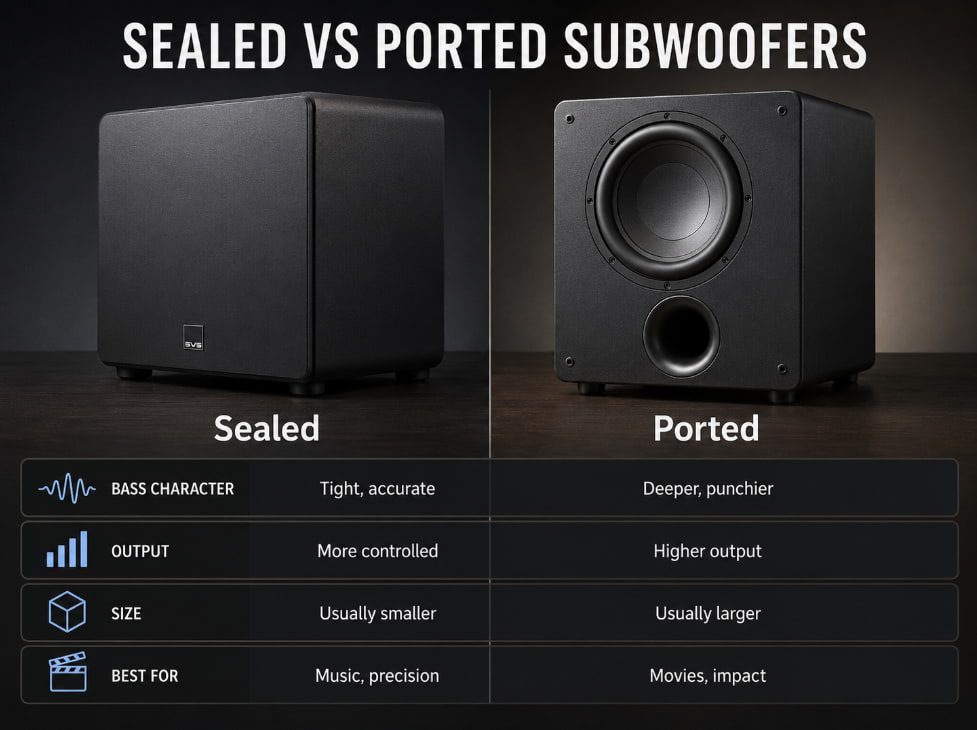
Subwoofer Choice Depends on Output and Accuracy
Multiple subwoofers often perform better than one expensive single subwoofer because they provide smoother bass across more seats.
Sealed subwoofers usually provide tighter and more accurate bass, making them suitable for music and critical listening.
Ported subwoofers can offer deeper extension and higher output, which is useful for dramatic movie effects.
How Do Acoustic Treatment Options Compare?
Different treatment types vary in cost, appearance, and performance. The right choice depends on the room’s acoustic goals and design style.
| Treatment Type | Cost per m² | Aesthetic Impact | Effectiveness | Best Applications |
| Fabric Panels | $80–150 | Customisable | High absorption | First reflections, rear walls |
| Bass Traps | $100–200 | Visible or concealable | Targeted low-frequency control | Corners, ceiling joints |
| QRD Diffusers | $150–300 | Architectural | High diffusion | Rear walls, ceilings |
| Perforated Panels | $120–250 | Integrated | Hybrid absorption and reflection | Millwork integration |
| Acoustic Plaster | $200–400 | Nearly invisible | Moderate absorption | Ceilings, feature walls |
| Fabric Wall System | $150–300 | Highly customisable | High | Full room treatment |
Conclusion
Home theatre acoustics bring together science and design. The goal is to create an entertainment space that feels immersive, clear, and comfortable while still matching the overall style of the home. In luxury residential interiors, acoustic performance should not make the room look overly technical. Concealed acoustic panels, fabric wall systems, custom millwork, and integrated ceiling treatments can help the space sound better while keeping the design polished and elegant.
For Bangkok condominiums and apartments, acoustic planning is especially important. Neighbuor proximity, HVAC noise, limited room volume, and shared structural walls can all affect the final result. This makes sound isolation, vibration control, speaker placement, and subwoofer positioning just as important as the audio equipment itself.
For homeowners who want a home theater that looks refined and performs well, working with a design company can make the process easier. Instyle Deco Paris offers Bangkok Interior Design Services for residential and commercial spaces, including home theatre design, 3D planning, space planning, custom furniture, renovation coordination, and installation support. Their approach can help homeowners combine acoustic needs with elegant interior design, so the final space feels both functional and visually complete.
FAQ
What is the ideal room size for a home theatre?
There is no single ideal size, but rooms between 50 and 150 cubic metres usually provide good acoustic performance while still allowing comfortable seating.
Larger rooms allow better bass distribution and higher volume capability. Very small rooms, especially those under 40 cubic metres, often struggle with bass modes and pressure issues.
How much acoustic treatment do I need?
The amount of treatment depends on the room size, construction, and desired performance level.
As a starting point, treat the first reflection points on the side walls and ceiling. Add absorption on the rear wall and bass trapping in the corners. For more accurate results, a professional acoustic analysis can determine exactly where treatment is needed.
Can I have good acoustics in an open-plan space?
Open-plan spaces are more difficult because they lack proper boundary control and allow more noise intrusion.
Some improvements are still possible, such as focused speaker systems, room correction, strategic absorption panels, and automated masking systems. However, for serious theater performance, a dedicated enclosed room is usually better.
How do I balance acoustics with interior design?
Modern acoustic treatment offers many design-friendly options.
Fabric-wrapped panels can match the room’s décor. Wood diffusers can become architectural features. Treatment can also be hidden behind fabric walls, millwork, or ceiling details. The best results come from collaboration between acoustic designers and interior designers.
What is the 38% rule and why does it matter?
The 38% rule suggests placing the main listening position 38% of the room length from the front wall.
This position usually avoids the worst bass problems caused by axial room modes. It is not a perfect rule for every room, but it is a strong starting point for seating placement.
How can I reduce sound transmission to neighbors in a condo?
Useful strategies include decoupled wall and ceiling construction, mass-loaded vinyl, acoustic sealant, floating subwoofer platforms, and subwoofer placement away from shared walls.
Complete sound isolation usually requires major construction, but even partial measures can make a noticeable difference.
Do I need professional acoustic design?
DIY acoustic treatment can improve basic rooms, but professional design is worthwhile for dedicated luxury home theaters.
A professional can optimize room ratios where possible, recommend the right treatment, manage bass issues, and ensure the equipment suits the space. This investment is usually small compared to the total theater cost but can greatly improve the final experience.
How does ceiling height affect theater acoustics?
Higher ceilings, especially those above 3 metres, can improve room volume and provide more space for height speakers.
Standard 2.7 to 3 metre ceilings can work well with proper treatment. Ceilings below 2.4 metres may limit Dolby Atmos performance and create more pressure-related issues.